The Financial Seminary
7403 Divot Loop
Bradenton, FL 34202
ph: 941-544-5976
garmoco
- Home
- The Omega Series
- Guest Articles

- In The News
- Articles
- Ayn Rand & Donald Trump
- Losing Faith
- Does Our House Divided Need...
- Reaganomics
- Pursuing Ponzi Protection
- Does God Want You to Be Rich?
- Responsible Capitalism
- Introducing Stewardism
- Thanksgiving Sermon 2011
- The 9.5* Theses of Stewardship
- Charity in Truth
- Blessed to be a Blessing
- The People vs The Prophets
- Email to Christianity Today
- Holiday Meditation
- Resources
- On Ayn Rand
- Videos
- POWERPOINTS
- About Us
- Contact Us
- Archive
Class Sixteen
"It is possible to envision a time when evangelicals have the 'consistent Christian perspective tools' [or worldview if you're Chuck Colson] they require in the area of life. But it is probably best to expect Christian theology for life under modern high-tech capitalism to come mainly from where it now does-- from Jewish, Catholic, Reformed, and Lutheran sources, in which traditions exist for relating doctrines of creation to matters of redemption in a modern economic context."
Professor John R. Schneider
Calvin College
As regular readers know, I believe our perceptions of the economy are increasingly shaped by not by economists but by political propagandists as in the world of politics, perception is reality, even if they're capital losses when investing. The book I've been working on is actually about the many illusions we experience in American culture. I've just discovered the illusions of Wall Street are the topic of John Bogle's latest book. He of course is the respected founder of the Vanguard funds who has turned his attention to financial ethics. So I just might be to something.
It's therefore critical that we begin by thinking clearly about the old adage that religion should comfort the afflicted while afflicting the comfortable who have the resources, be they financial or political, to create those illusions. Yet the admonition we are to be as gentle as doves but as wise as serpents suggests we should never practice self-sacrifice unwittingly. And while I certainly hope our hard earned savings earns a fair return, I'm increasingly concerned capitalists, including too many of us, are slowly killing the goose that lays the golden eggs. That's always been a problem for secularists who want their rewards here and now. But even cultural Christianity should know better.
For new readers, I've long believed our journey away from such realities began during the recession of the early nineties. Our anxieties turned an unfortunately pessimistic economic book into the book-of-the-year in American evangelicalism in 1992. In its updated edition, the author essentially confessed he helped elect President Clinton, whose campaign theme agreed our major problem was "the economy stupid. Of course, we complained the next eight years. Yet Christ counseled we give no thought for the economic future but to seek the spiritual kingdom today. C.S. Lewis therefore summarized the Judeo-Christian approach to economics by saying if we shoot for heaven, we'll get earth thrown in; but if we shoot for earth, as materialists do, we'll get neither. Yet millions of cultural Christians--who are inevitable, even desirable in evangelicalism due to our focus on converting non-believers into new-born believers--voted, and continue to vote, their wallets. Many continue to believe the American dream has died due to the federal debt and/or government. As we have so few economic thinkers and are therefore so focused on politics and/or sexuality, few of us have noticed the so-called "smart money" has been doing quite well materially despite living in the same culture we do. So even though it's well-documented that relatively few of us are among the most educated and affluent, we helped Presidents Reagan thru "W" empower the disciples of Ayn Rand, primarily through Alan Greenspan, to deregulate those cultural elites who are focused on material wealth creation. We also helped lower their taxes further and further.
That was likely a good thing thirty years ago and I offer no apology for helping it happen by supporting Reagan. The affluent were being taxed at rates up to ninety percent. As an investment counselor, I knew they were wasting a lot of that income on useless real estate tax shelters and so on. But that hasn't been true in sometime. Amazingly, we still seem to believe our primary problem is America is going bankrupt and the dream is dead. Yet that is only true for us and is largely due to our politicized misperceptions being self-fulfilling. But we continue to support the same public policies that will increase the size of the economic pie for the affluent. Economists are apparently correct that despite the social pathologies inequality may create, it does encourage economic growth. Seems we rats run faster and faster to get a taste of the pie, at least until we are exhausted, as many Americans are today. But we probably passed the point of needing policies that help the pie to grow for middle and lower class America years ago. And of course, if you continue to believe America's primary problem is the pie isn't large enough, you're also tempted to add distasteful fillers like casino gambling, lotteries and so on that don't really improve the quality of life for most. Hence evangelical resistance to socially responsible investing, which is largely focused on investing in the less than affluent.
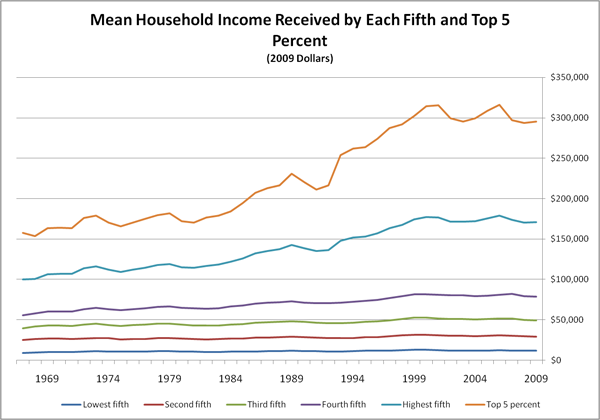
We therefore desperately need an objective look at America's assets--or a simple trip abroad or to Walmart--to dispel the myth that America doesn't have enough wealth, even if that myth is baptized as scarcity theology. In fact, corporations are sitting on record piles of cash as profit margins are at an all-time high. While individual investors still have little confidence in stocks, corporate profits have just increased at a faster rate than since 1900, according to Professor Robert Schiller of Yale. Many corporations pay few if any taxes. So CEO's are again being rewarded with salaries Peter Drucker declared obscene while nearly 16% of Americans are non- or under-employed.
John Bogle says if you don't make more than a hundred million dollars annually as a hedge fund manager, you 're still in the minor leagues. Warren Buffett says the incomes of hedge fund managers have been taxed at lower rates than his secretary's income as the managers get to classify their incomes as capital gains. But Congress has just increased the estate tax limit. Even Forbes has confessed the most rewarding tax breaks go to the super-rich, rather than mere millionaires. That's huge as hedge fund managers, professional athletes, entertainers and the Forbes 400 now garner the highest percentage of GDP, and control a higher percentage of our wealth, than any time since 1929, an ominous year. Yet Forbes continues to celebrate ungodly wealth concentration. Purposeless day traders are now parasitic split-second traders. Bankers recapitalized by the public purse ignore the biblical law about seventh year debt forgiveness for those who truly can't pay. The Wall Street Journal even said on April 1st that subprime mortgage bonds are back, and it didn't intend the story to be an April Fool's joke.

Source: Private Sector Development Blog, 3/10/10
I've long been bullish on the American economy. The primary reasons are 1) the Bible says a man is as he thinketh and American men now think about money more than sex, and 2) books from the Bible to Extraordinary Popular Delusions and The Madness of Crowds have indicated we usually learn something from disasters even if it's only for a short while. But the fact that very little seems to have changed since the credit crisis leading to the Great Recession is making me very nervous. I attribute our complacency to the fact few of us have time to read those books as we're watching and listening to politicized media 24/7. And it's a heck of a lot easier for those with degrees in political science, communications and religion to explain the latest tick of the federal debt clock than to explore the pathologies of the American economy. So leaders like Dick Armey, the same of Newt Gingrich's 1994 revolution, again threaten to shut down government by insisting on the same policies of the Republican Party that have been repackaged as the new ideas of the Tea Party. The right-wing of Congress continues to rail about the federal debt while still seeking to cut income taxes even further for the affluent. That virtually assures deficits will continue far into the future. A few call for growth without defining for whom. It all brings to mind two modern proverbs: 1) growth for its own sake is precisely the philosophy of the cancer cell, and 2) John Steinbeck saying if he wanted to destroy a nation, he'd give it too much and have it on its knees, miserable, sick and greedy. My guess is more Americans are on their knees for that reason than prayer these days.
The author of the 1992 book was a friend. And he usually based his counsel on biblical principles, albeit carefully selected ones that appealed to his libertarian-leaning readers and listeners. So it sounded more like Darwin, Nietzsche and Ayn Rand than Moses, Christ and St. Paul when he wrote: "As cruel as it may sound, from the long-term perspective of the economy, it would be better to raise taxes on the poor than on the wealthy. It is only the wealthy--the people who have surplus money--who are able to invest in industries that create the jobs and wages that make it possible for the poor to escape their poverty." I simply can't find that in the biblical plan of exodus.
Of course, the economic plan he endorsed has long been favored by cultural elites and called "the trickle-down theory" by others. I questioned that policy recommendation in a book I wrote in response to my friend during the mid-nineties. My friend didn't like it but my other friend Sir John Templeton, who was a devout believer in responsible capitalism as well as a Rhodes Scholar in economics, used to tell us that while money usually doesn't trickle down, influence does. Like Buffett, John advocated a 98% estate tax so the affluent would give their money to charity rather than children who would likely be hurt by it. Still, many evangelical Christians have joined the economic libertarians of the Tea Party in arguing for lower taxes on the affluent and fewer benefits to the middle and lower classes. Perhaps we think they'll see the light and practice charity. We need to read Ayn Rand. We also need to understand even more hard realities about our economy than simply the fact the Bush White House estimated America's net wealth at nearly $120 trillion while saying our federal debt compared to assets had in fact been in decline since 1960.
I should preface these other facts by paraphrasing the Bible and saying I believe there are times for Keynesian stimulus (as during a severe recession) and times for Austrian austerity; times for tax cuts and tax increases (such as wars); times for monetary expansion and times for monetary stability. I also believe those who dogmatically advocate one secular economic approach are like the proverbial stopped clock: easy for all to understand but of no help to anyone most of the time. Finally, I believe America needs a strong government, strong businesses and strong non-profits. The notion that one sector of the economy should destroy one, or both, of the others seems quite counter-productive. Now let's seek economic truth and see if we can't stop shooting ourselves in the foot. If we no long believe that reality about the root of all evil, perhaps we'll believe Pogo about the enemy being us.

Source: The Motley Fool, February 25, 2011
One myth of scarcity theology is that America has lost its manufacturing base. In reality, it has lost its manufacturing jobs, as indicated in the chart above. Despite those political ads about China owning America, which I believe terrorize the American worker as well as investor, the April 2nd issue of The Economist said: "America remains the world's largest manufacturer. Both America and Japan roughly doubled manufacturing output between 1980 and 2009; nowhere in the G7 has output declined in absolute terms. Lower-end manufacturing has indeed moved to countries like China, with their masses of cheap labor, but it is not obvious why this pattern of comparative advantage should be resisted." In other words, employees who've survived in the big companies are now manufacturing computers rather than buggy whips. If you have the skills to make computers, you're happy. If not, you're probably angry at Washington. Many employees who could still find jobs in the service sector of the private sector have also had to produce for less real compensation, as indicated by the chart below. And now public employees are being told they are over-paid in relation to private employees, which shouldn't be surprising. Not to sound like Karl Marx even though a blind pig occasionally sniffs out an acorn, even Henry Ford, the earliest of capitalists, knew you have to pay employees so they have money with which to buy your products. Unfortunately, that may no longer be the case in America.

Source: MSN Money, March 2, 2011
Some capitalists have apparently forgotten they can cut their way to short-term profit at the expense of long-term growth. That's simply one more of the social responsibilities corporations often deny as they claim the same rights as individuals. Of course, even those of us who believe in free but fair markets have to admit claiming rights without corresponding responsibilities is the philosophy of the psychopath. The psychopathic tendencies of both parties are undoubtedly why the March 26th edition of The Economist asked: "Are you better off than you were two years ago? Although the economic recovery in the developed world is almost two years old, the average Westerner would probably answer "No" The authorities have applied shock and awe in the form of fiscal and monetary stimulus. But the benefits of recovery seem to have gone almost entirely to the owners of capital rather than workers. In America total wages have risen by $168 billion since the recovery began, but that has been far outstripped by a $528 billion jump in profits. Dhaval Joshi of BCA Research reckons that this is the first time profits have outperformed wages in absolute terms in 50 years....Are these trends toward a belated vindication of Karl Marx? The bearded wonder wrote in 'Das Kapital' that: 'It follows therefore that in proportion as capital accumulates, the situation of the worker, be his payment high or low, must grow worse.'...Wages still account for a much greater slice of income than profits, but labor's share has been in decline across the OECD since 1980. The gap has been particularly marked in America; productivity rose by 83% between 1973 and 2007, but male median wages rose by just 5%."
Can we change things? Only by changing ourselves. Over the years I've advocated investing in a community development bank that finances job-creating activities on the local level. Now, I'm also investing in mutual funds that have bought variable rate loans that banks have made to smaller and medium-sized companies, the kinds that create jobs for Americans. Huge companies can tap the bond markets but smaller companies often rely on bank loans. Those loans might even perform better than bonds if interest rates rise. Second, I've stopped pushing the CEO's of even the socially responsible companies I invest in for quarter to quarter earnings gains. And third, I've stopped supporting all those politicians who pray "God bless America." I now look for any, regardless of party, who pray "God guide America," meaning those who understand God can't bless America while its economic policies are guided by Ayn Rand. It's not impossible. I may have found one only recently at a dinner for The Christian Embassy, a Washington-based ministry of Campus Crusade. Former Congressman Gresham Barrett noticed the Embassy's brochure said it reaches out "to those who can change the world." He began his talk by confessing he could do no such thing but since losing the governorship of South Carolina, he's come to know Someone who can. That's real change...of the positive sort.
****
Gary Moore is a Sarasota-based investment counselor who has authored five books on the morality of political-economy and personal finance. He is a representative of, and securities offered through, National Planning Corp (NPC), member FINRA/SIPC, but opinions expressed here are his alone. The Financial Seminary and NPC are separate and unrelated. His comments are included in the More Good $ense newsletter in an effort to expand stewardship leaders’ understanding of broader economic issues.
7403 Divot Loop
Bradenton, FL 34202
ph: 941-544-5976
garmoco